Smith College Club of the East Bay
Book club
Home
Book club
Performances
Bulletin board
About the club
Becoming a member
Recruiting students
Community involvement
Newsletter
Events
EBSC photos
Ivy Alliance
Links to EBSC alum sites
On campus
Contact us

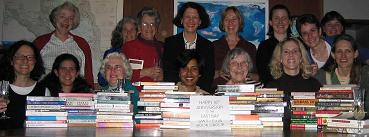
Thanks to Catherine for hosting a Mexican-themed bookclub meeting to discuss The Hummingbird's Daughter by Luis Alberto Urrea on the warm evening of June 17th 2008. A dozen readers, classes 1947 to 2002, gathered in her living room to discuss the long book which most had managed (and struggled) to finish. It wasn't a slow read once everyone got going, but it is 528 pages. Some said it paled in comparison to the classic One Hundred Years of Solitude, but many in the room loved it, hailed it our best book of the year. The story was engaging and unpredictable and unfolded to the sainted heroine coming into her power and using it for good. She was a religious figure, but she preached politics. She healed the sick, but she didn't work during the night and she knew she couldn't save everyone. The characters were many and the details of their wounds explicit. The scenery was rich and visible through the descriptions of the land, the revolution intermingled everywhere.

We were amazed that the story is based on a real person, a distant relative of the author, and how smoothly he wove fact and fiction together. We talked about the relationships between the main characters, and our lack of education about the Mexican revolution and the importance of raising our consciousness about the history and politics of Mexico and Canada, our geographical neighbors.

Wikipedia history of the period in Mexico

Thanks also to Anne, visiting from France, who did Internet research that enriched our collection of facts for the discussion.

More about Teresita from the author on his website.

Next book club meetings:

Date:
Sunday, July 20, 2008
Time:
4:00 pm
Place:
Book:

Read the book! See the play! Join the East Bay Smith Book Club for our annual summer theater outing: a performance of An Ideal Husband by Oscar Wilde at the California Shakespeare Theater in Orinda:

An unwelcome visit from the past calls the future into question for a successful, young, and happily married politician. Behind Wilde's trademark razor-sharp wit lies a profound observation of the illusions we use to deceive others and--more importantly--ourselves. Artistic Director Jonathan Moscone, fresh from his acclaimed production of Man and Superman, directs Wilde's timely comedy. --from CalShakes website
If you did not reserve a spot, you can still buy a ticket on your own and join us! We are attending the Sunday July 20 4PM matinee, sitting in section D. Buy tickets soon, because this is expected to be their most popular play this season.

Even if you cannot get a seat with the group, you can dine with us at the pre-show picnic!

From wikipedia: An Ideal Husband is a 1895 comedic stage play by Oscar Wilde which revolves around blackmail and political corruption, and touches on the themes of public and private honour. The action is set in London, in "the present", and takes place over the course of three days. "Sooner or later," Wilde notes, "we shall all have to pay for what we do." But he adds that, "No one should be entirely judged by their past."

You can read the book online or download it from books.google.com! (You probably need a gmail login to access it.)

RSVP:

Email Monica if you want to attend the potluck before the performance.

Date:
Thursday, August 21, 2008
Time:
7:30 pm
Place:
Jennie's in Oakland
TBA
Book:
Poetry by Billy Collins: Sailing Alone Around the Room: New and Selected Poems (2001, ISBN 0-375-50380-3), named a notable book of the year by the New York Times Book Review.

Everyone is invited to pick a poem you'd like to read aloud to the group.

RSVP:

Email Jennie

2008 Schedule
For 2008 we are trying a pattern for scheduling, so we spend less time at each meeting setting the next date, but also have variety so that people with set, conflicting schedules will be able to attend sometimes. The table below shows the complete list of book club meeting dates for 2008.

Wed 1/16/08
Thu 2/21/08
Wed 3/19/08
Wed 4/16/08
Thu 5/15/08
Tue 6/17/08
Sun 7/20/08*
Thu 8/21/08
Tue 9/16/08
Wed 10/15/08
Thu 11/20/08
Tue 12/16/08

* Group outing to California Shakespeare Theater preemtps normal schedule
 
Scroll down to see write-ups about books we've read lately and the discussions that ensued.

Buy books at local bookstores!

There are frequently used copies of bookclub books at various local bookshops. See the list of East Bay local bookstores at http://www.nciba.com/stores/east.html.

Smithie favorites include Black Oak in North Berkeley, Pegasus in downtown Berkeley, Pendragon and Diesel in Rockridge, and Walden Pond on Grand near Lake Merritt.


Book club reading list to date (requires Acrobat Reader): EBSCBookClubReadingList.pdf (last updated 5/07)
 
Donations raised at EBSC Book Club meetings go to the scholarship fund the club sponsors (details on the About the club page).

Suggested titles make up a long list we're starting to keep, with additions a healthy constant: EBSCBookSuggestionList.pdf (file last updated 6/04, whoops! Need to update.)

Looking for more reading lists? See the KQED Forum reading lists and the KQED Arts & Literature site.

KQED's Forum program hosted a book club featuring fiction about California and by California authors in 2004. See http://www.kqed.org/programs/radio/forum/calreading for the list of books discussed.

amazon.gif

If you order books from Amazon, please use this link or the link on the AASC page so that Smith benefits from your purchases! The Alumnae Association receives a contribution every time you purchase a book from Amazon.com through the Smith web site. Your purchases help to support programs for alumnae and undergraduate students. Thank you!
 

Recent Readings

Ruth worried that we would melt in our books during the heat wave on May 15th, but instead we were able to comfortably sit out on her deck into the warm evening, many of us in sandals and sundresses. Ten of us from classes 1947-95 talked about the content and import of Barack Obama's The Audacity of Hope, as well, of course, as our thoughts on how his future and that of our country may influence each other. Older alums talked about what the party conventions were like many years ago, when the candidates were not elected ahead of time as now typically happens through the primaries.

We debated the hot topic of whether voters are more likely to elect a woman president or a black president, and several readers shared their ambivalence about supporting Clinton because she is a strong woman contender, yet allowing that Obama has a freshness that we may all need.

We enjoyed Obama's writing and the clarity with which he expressed his ideas, and admired his statesman-like quality which was so evident in his speech on race.

A More Perfect Union - Watch Barack's speech on race in America and building a more perfect union. (37 minutes)

Barack Obama's Speech on Race - The text as prepared for delivery of Senator Barack Obama’s speech on race in Philadelphia, as provided by his presidential campaign March 18, 2008.

Several readers had read Dreams of My Father as well, and appreciated the content and delivery of each. We wish we had a book of Clinton's to read that would provide as much insight into her politics and policy ideas!

Thank you, Ruth, for hosting!


Thank you to Monica for hosting our April 16th discussion of Suite Française, by Irčne Némirovsky. While Maggie felt the book did not give a very balanced view, focusing as it did on a relatively small segment of the French population, all were impressed by her writing (and perhaps just as important, the work of her translator), and her ability to capture her characters' experiences so vividly. The effects of war and occupation on ordinary people and their differing reactions are illustrated very well. The fact that it was written contemporaneously to the events, and our knowledge of Némirovsky's fate, made reading the book much more intense.

The topic of military occupation led us to a discussion of our own occupation of Iraq. Janet, Nancy and Monica have been attending a course offered by the Osher Lifelong Learning Institute, titled Conversations in History. They were especially struck by host Harry Kreisler's recent interview with Colonel Lawrence Wilkerson, U.S. Army (ret.) Chief of Staff to the Secretary of State (2002-2005), discussing the break down of the national security process in the administration of George W. Bush. They highly recommend the video of the interview (duration 58:25) in which Colonel Wilkerson offers an insider's view of the Cheney-Rumsfeld cabal that drove American policy in the wake of the Al Qaeda attack on 911. The Vice President's manipulation of the policy process, he argues, led to a lack of a post conflict planning for Iraq and the failure to abide by the Geneva conventions. Wilkerson also analyzes the motives of Cheney and Rumsfeld, their penchant for secrecy, and speculates on the long term costs to American democracy, power and prestige.

On a related subject, Sarah spoke up for the dismissal of law professor John Yoo from UC Berkeley's Boalt Hall Law School as advocated recently by the National Lawyers Guild. In a memorandum written the same month George W. Bush invaded Iraq, John Yoo said the Department of Justice would construe US criminal laws not to apply to the President's detention and interrogation of enemy combatants. According to Yoo, the federal statutes against torture, assault, maiming and stalking do not apply to the military in the conduct of the war. Academic freedom and grounds for dismissal of tenured professors were warmly discussed in our group. Christopher Edley, Jr., Dean of UC Berkeley School of Law expresses his position on the subject (and John Yoo) in this essay.

As usual, our discussion touched on a wide range of topics, many politically focused, which led us to our book selection for May: The Audacity of Hope, by Barack Obama. (At least one person said she'd bought the book awhile ago but not gotten around to reading it yet, and it certainly is topical, so we decided it was time.)

Here’s a review from Publisher's Weekly:

Illinois's Democratic senator illuminates the constraints of mainstream politics all too well in this sonorous manifesto. Obama (Dreams from My Father) castigates divisive partisanship (especially the Republican brand) and calls for a centrist politics based on broad American values. His own cautious liberalism is a model: he's skeptical of big government and of Republican tax cuts for the rich and Social Security privatization; he's pro-choice, but respectful of prolifers; supportive of religion, but not of imposing it. The policy result is a tepid Clintonism, featuring tax credits for the poor, a host of small-bore programs to address everything from worker retraining to teen pregnancy, and a health-care program that resembles Clinton's Hillary-care proposals. On Iraq, he floats a phased but open-ended troop withdrawal. His triangulated positions can seem conflicted: he supports free trade, while deploring its effects on American workers (he opposed the Central American Free Trade Agreement), in the end hoping halfheartedly that more support for education, science and renewable energy will see the economy through the dilemmas of globalization. Obama writes insightfully, with vivid firsthand observations, about politics and the compromises forced on politicians by fund-raising, interest groups, the media and legislative horse-trading. Alas, his muddled, uninspiring proposals bear the stamp of those compromises.

Copyright © Reed Business Information, a division of Reed Elsevier Inc. All rights reserved.

(posted by Sherrill)


We had a terrific turnout of around 35 people on Wednesday, March 19, for a discussion of Joan Didion's The Year of Magical Thinking lead by Jennifer Walters, Smith's Dean of Religious Life.

Dean Walters started off by introducing herself and mentioning a project she's been involved with recently on defining success, including a five-day January term course called "Get A Life", in which juniors and seniors began to develop a habit of reflection about their own values and goals. They talked and wrote about themes inherent in making life decisions, including perfectionism, risk-taking, tolerating failure and family narratives of success. Many alumnae in the audience agreed that they could use such a seminar now! She also mentioned that she had taught The Year of Magical Thinking in combination with Going Sane, by Adam Phillips during J-Term 2006.

We then moved on to a discussion of the book, with Dean Walters first asking if anybody had a negative response. Several alumnae found Didion cold, self-absorbed and/or personally unlikable, and some were surprised at the lack of spirituality in her approach to death, but others (especially readers of her other books) felt that Didion was more open in this book than usual, and that exploring experiences through words is how she makes sense of them.

The personal reflections that the book engendered tended to differ based on the age of the reader. Older alumnae found themselves considering the possible loss of their own partners, while younger alumnae were more likely to be dealing with the loss of parents. Several in the group shared their personal experiences and reflected on how Didion's story and storytelling compared with their own, and in some cases, helped them understand it better.

Dean Walters pointed to the liturgical patterns found in the book, and noted especially the power of Didion's introductory words, repeated again later in the book, to invoke the rapidity and profoundness of the change in her life:

Life changes fast.
Life changes in the instant.
You sit down to dinner and life as you know it ends.

Didion's relentless search for understanding the technicalities of what happened and the exact timing of events struck a chord with many, and was echoed by an alumna who had lost her father and experienced a similar pattern. Also remarked on was the fact that the interludes of more "technical" information interspersed with her memories helped the structure and flow of the book considerably.

Dean Walters was asked what the reaction of undergraduates was to the book, in comparison to ours. She said that they tended to focus more on Didion's reactions: the magical thinking of the title, and how her mind reacted to her situation, rather than the more personal aspects of the loss. This is perhaps explained both by their age and also that they were reading it in conjunction with Going Sane which explores the delicate balance between sanity and insanity.

All in all, it was a very interesting and enjoyable evening. As might be imagined with a group this large, there was a certain amount of waiting your turn to be heard, but I think (hope!) most were able to offer their comments.


Just down the hill from the Mormon Temple in Oakland, Sherrill hosted a small but lively bookclub discussion of Under the Banner of Heaven: A Story of Violent Faith by Jon Krakauer on Thursday, February 21, 2008. With five Smithies and a visiting mother in Sherrill's cozy, firelit living room, and one Smithie on speakerphone, our diversity spanned not only geographical location but several decades of graduations (as usual). The technological participation also included several comments Sherrill received from people who couldn't attend the meeting but shared their thoughts about the book via email.

We were all fascinated and horrified with the information we'd learned in the book, specifically certain Fundamentalist Mormon practices such as older men marrying girls as young as 14 (usually pressuring them with threats of hellfire in the afterlife if they don't do as they're told). Although no Mormons were present at our meeting, most everyone has known Mormons, who were probably the mainstream Mormons, not the Fundamentalists who are the ones who believe in polygamy. Despite their reputation for traveling on international missions, Mormons in daily life, in our experience, do not talk about being Mormon nor prosthelytize.

The strong community that the Mormon church provides does seem valuable, and in one anecdote it helped one man to overcome addiction and continue to law school and a successful family and life. A years-ago magazine article Jennie's mother read described how the plural wives enjoyed each other's company and appreciated sharing the husband and the child-rearing.

At the philosophical level, Krakauer spent a chapter near the end covering the legal issues surrounding Ron and Dan Lafferty's murder trial; we discussed how to live in a society of people, we all have to agree to follow the rule of human law, because God's law, as those brothers claimed to follow above all else, is too subjective. If a man follows his god's command, is he insane?

Conversation also touched on former presidential candidate Mit Romney, the Mormon voting bloc, the current case of Warran Jeffs, comparison to Islamic Fundamentalism and that strong, male-dominant community, the mystery of the sacred undergarment (perhaps not unlike the Jewish Orthodox tallit katan?), and the confusing order of Krakauer's storyline, which jumps from past to present and from place to place so that it's sometimes hard to remember all the names.


Sixteen Smithies circled up in Maggie's living room on Wednesday, January 16, 2008 to discuss Sara Gruen's Water for Elephants after catching up with each other while getting tea and snacks. Everyone enjoyed the book, though several thought it fluffy and predictable and the ending a little much (yet abrupt). Returning to this month's book intermittently, conversation diverged to Devil in the White City which was suggested last time but not selected (but may be for a future meeting) and the Chicago World's Fair of 1893, animal rights and zoos -- particularly the San Francisco Zoo which has been recently in the news, and, typically for this group, to the upcoming primaries.

We also ended up having several book suggestions, each igniting a small discussion, finally, after a re-count, the (slim) majority voting for Free Lunch: How the Wealthiest Americans Enrich Themselves at Government Expense (and Stick You with the Bill) by by David Cay Johnston, but it's not yet available in paperback, so we will read the second place finisher in the voting, Jon Krakauer's Under the Banner of Heaven for our February meeting. Other suggestions included Suite Francaise by Irčne Némirovsky (NYT review).

After the meeting was over, many people lingered, chatting in small groups about various topics including gyms and exercise approaches, children and family names, and the upcoming Festival of Women Authors at the Berkeley YWCA (among many other interesting local events we wish we had time to attend!).

Thank you for hosting, Maggie!


Already a supporter of the Central Asia Institute, Nancy hosted a warm discussion on December 11, 2007 of Three Cups of Tea: One Man's One Man’s Mission to Promote Peace...One School At A Time by Greg Mortenson & David Oliver Relin. Some people were put off by the writing, which particularly in the beginning is not so good, but once the story gains its momentum, it doesn't even matter. This story of one man's effective passion to help mountain villagers build schools in northern Pakistan compelled many of us, yet the marketing pitch that hovers underneath the story and the lucky access to funds for his efforts turned other readers sour at Mortenson (who did not write the book, it was more of a biography about him -- though did provide journal entries and immense amounts of other information).

Despite the heat of the discussion about the book (always better for the clash of strong opinions!), the subject soon shifted to US foreign policy, then to the 2008 presidential elections, the impact of Oprah's endorsement of Obama, and on to Smith's reputation and our various experiences there from the era of house mothers and no men allowed to the 2000's when students have every resource needed to succeed from tutoring to stress-reduction workshops. Touching on the range of mother-daughter relationships from very close (talking every day, sharing almost too much information) to distant (deliberately establishing space between), we wrapped up with some book suggestions and had a strong preference for fiction next time.


Our November exploration of Jane Austen's Emma occurred at multiple events:

The "real" book club meeting was held at Betsey's on Wednesday, November 14th. Sherrill reports: "I arrived late, so missed some of the discussion, but in the part I did join we discussed the class system so evident in Austen's work, especially Emma, and wondered whether Austen was simply vividly illustrating what she saw, or offering a critique, however mild. We also offered some ideas on modern writings that explore character and setting as Austen does, and touched on Zadie Smith's work as in some ways similar. Thanks to Betsey for hosting!

A small group of folks who were unable to make that meeting instead gathered at Catherine's the previous evening for a viewing of the 1996 film production of Emma starring Gwyneth Paltrow as the title character, and Jeremy Northam as her Mr. Knightley. Attendees were at various stages of reading the book, which provided interesting differences of perspective on the movie. We all enjoyed this film version, which was very well cast, with the notable exception of Ewan McGregor as Frank Churchill. His acting was unexceptionable, but he had a very peculiar fluffy hairstyle, which made it hard to see him as the dashing Mr. Churchill.

Our double feature also included the 1995 Clueless, an adaptation of Emma set in Beverley Hills, with the brutal class society of high school standing in for the English countryside. Most attending had seen Clueless years ago, although not all had realized it was based on Emma. While we found it amusing and it certainly evoked a particular time and place, its wit did not seem quite as sparkling when one had recently read Austen's original.

Back to non-fiction for December!


We welcomed two new faces to book club at Catherine's on Thursday, October 11: Ruth McNaughton and Frances Bell, as well as many old friends. Catherine had a nice assortment of treats, and her organic farm box prominently displayed. :-) Thanks for hosting!

As expected, our discussion of Michael Pollan's The Omnivore's Dilemma was lively and interesting. Some felt that Pollan's tone was a bit precious or self-absorbed at times, but all found sections that resonated strongly, and believed the book very worthwhile. All of us came away feeling that US industrial food production is even worse than we had feared.

Whole Foods comes off poorly in the book, but Catherine reported some very interesting developments since its publication. John Mackey (Co-founder and CEO of Whole Foods Markets) engaged in discussions with Michael Pollan, first in public letters and then in a live Q & A forum in Berkeley, and many changes have been made at Whole Foods. A video of the Berkeley discussion is available on the Whole Foods website: john-mackey-and-michael-pollan-discussion and was highly recommended by Catherine.

You can read their letters back and forth from Pollan's website: pollan_mackey_letters.

Another point of discussion was what can we do to help change the situation. Michael Pollan's answer is the farm bill. Ruth sends this link to an NPR interview with Pollan and others: How the Farm Bill Affects What We Eat.

For a bit of relief, we opted for fiction for November, and scheduled the December meeting, so folks could plan ahead.


Of the group that gathered at Aimee's on September 5 to discuss M.F.K. Fisher's book The Gastronomical Me, only I had read any other Fisher before. I think it gave me a different perspective from others, most of whom seemed to feel that they weren't getting enough information from the author about her life and times, only ruminations on food. Since I'd read other Fisher, I knew better what to expect, and the few autobiographical details that she did reveal were more interesting to me as well, most likely. Unsurprisingly, it also helped if you were interested in cooking.

Here are some details I got from Wikipedia, to fill in some of the blanks:

    Fisher was born Mary Frances Kennedy in Albion, Michigan. While studying at the University of California in 1929, Fisher met her first husband, Alfred Young Fisher. The couple spent the first formative years of their marriage in Europe, primarily at the University of Dijon in France. In 1932, the couple returned from France to a country ravaged by the Great Depression.

    During the Fishers' years in California, they formed a friendship with Dillwyn "Timmy" Parrish and his wife, Gigi. Later, in 1938, Fisher was to leave Alfred for Timmy, referred to as "Chexbres" in many of her books, named after the small Swiss village on Lake Geneva close to where they had lived. The second marriage, while passionate, was short. Only a year into the marriage, Parrish lost his leg due to a circulatory disease, and in 1941 took his own life. She was involved in a number of other turbulent romantic relationships with men and women.

    Fisher later bore two daughters. Anne, whose father Fisher refused to name, was born in 1943. Kennedy was born during Fisher's short-lived marriage to Donald Friede, which lasted from 1945 to 1951.

    After Parrish's death, Fisher considered herself a "ghost" of a person, but went on to live a long and productive life, dying in California in 1992 at the age of 83. She had long suffered from Parkinson's disease and arthritis, but lived the last twenty years of her life in "Last House," a house built for her in one of California's vineyards.

(posted by Sherrill Lavagnino)


Our annual theater outing this year was to a Woman’s Will production of Romeo and Juliet, performed in the Chapel of the Chimes on August 9. The setting was perfect for a play whose final scenes take place in a crypt, although unfortunately the acoustics were bad, and the staging made it difficult to see from where most of us were sitting. A few of us met for a nice picnic beforehand out in the field by the cemetary.

Thanks to Monica for hosting 15 of us in her lovely sun-porch-living-room-with-a-view on Tuesday, July 31, 2007! We discussed Autobiography of a Face by Lucy Grealy and Truth and Beauty by Ann Patchett, a pair of novels (yes, despite the title "autobiography," Grealy explained it was a novel, and she is a writer) about Lucy's life and Ann's friendship with her.

Considering autobiography as novel is a challenge: several of us had thought of it as an autobiography, and therefore questioned differences in her telling compared to Patchett's, and we didn't even explore the nature of memoir writing and how inevitably the writer sees the life differently from at the moment she lived it!

We did discuss self-image: the beauty Grealy sought in vain and the love she thought would follow; Patchett's success as a writer (we read her Bel Canto a few years ago) compared to Grealy's one book in her short life; the difficulty of Lucy's life as a child with cancer and nearly 40 grueling and invasive surgeries on her face and jaw, and her loss of hope and addiction at the end of Lucy's life.

Having two points of view on the same life made for interesting conversation -- some readers related to one or the other of the authors more, and the differing perspectives on the shared parts of their lives provided a broader view of what Lucy's life was like than just she, herself, could present. The discussion of the books led to explorations of similar experiences in our lives, such as how friends at Smith helped each other through life's challenges. Across the ages, most of the group was glad to have read the two books in combination even though it was a heavy assignment for summer!


Monica started us off with a discussion about aging and exercise being recently back from her 60th reunion on the warm evening of Wednesday June 13, 2007 at Sophie's house in Berkeley. Gradually we moved on to our book of the month, The Space Between Us by Thrity Umrigar, whose main character, Bhima, was a woman in her 60s who worked as a servant for a Parsi woman. While the world of mistress-and-servent seemed like distant past to us, some speculated that in the American South some of those relationships between benevolent employer and long-time servant of the family, and indeed the arrangement of working mother and nanny is reminiscent, yet less interactive than Sera and Bhima sipping their tea from cups they do not share, one on a chair and the other squatting on her haunches. Umrigar's writing was engaging and although the time in the book moves backward and then forward again, no one felt distracted by that.

Several women mentioned other books about India and Indian culture in the U.S., and even suggested reading another because this was so engaging. Many of the stories are vastly depressing because of the difficulty of life for lower-caste and/or poor people in India, yet important for us in our privileged, Smith-educated position to be aware of as citizens of the world!

Sophie, thank you for hosting!

On Thursday August 9 we will have our annual summer theater outing to see Romeo and Juliet at the Chapel of the Chimes.


Thanks to Nancy for hosting book club on Thursday, May 17, 2007.

Sophie sends this write-up:

Eleven of us gathered for the book club meeting on May 17 at Nancy's house to discuss Flux: Women on Sex, Work, Love, Kids, and Life in a Half-Changed World by Peggy Orenstein. The conversation was lively as four generations of alumnae shared their own stories of choices they had made -- and the impact they felt those decisions have had on their lives. The range of experiences shared in Nancy's living room was as wide as that of the people interviewed in Orenstein's book. Some have chosen not to have children, others are single mothers, others have had their children later in life. We also looked at how expectations and issues have changed over the past four decades: finding a "Job" after college graduation has given way to selecting and meticulously orchestrating a "Career"; staying home to raise the children seems to have evolved from being a given, to being anti-feminist, to becoming somewhat of a status symbol today. A more prominent topic today also is the dynamics of juggling children, family, and work as a lesbian couple. Overall, the group felt that women have many more choices available today. And yet, most readers identified with the women in the book, who were reluctant to assume the role of the primary breadwinner -- though the Smithies last night said they enjoy the responsibilities and independence that come from contributing to the overall family assets. The younger alumnae noted that some of the book's messages might well influence their upcoming decisions on marriage, children and work. Ultimately, the group felt that the title of the book is very accurate and that more changes in the choices women can and do make are yet to come.


Thanks to Betsey for hosting April 25th's discussion of Jeanette Winterson's Written On the Body. The meeting was enjoyable as always, although the book did not seem as controversial to our book club group as it may have been when published in 1992. To the question "What gender did you think the narrator was?", most replied, "Female", though Jane said "Male", unhesitatingly. Several actively tried not to choose while reading, as I did. (I was unsuccessful, however, and could not help thinking it was a woman.) While the language of the book was praised, few found its vision of love "revolutionary" as the Washington Post Book World was quoted as saying on the back cover. Many suspected that the narrator's affair with Louise, although trumpeted as an entirely new experience, might end up as just another in a long list of ex-lover stories.

At the meeting we chose Michael Pollan's The Omnivore's Dilemma for our May book club. However, it turns out it is not yet in paperback. So, we'll put that off awhile, and instead read an alternate.


Marjane Satrapi's graphic memoir Persepolis: The Story of a Childhood drew quite a crowd to Jane's living room on February 13th, 2007! About 17 readers spanning the usual age-range (class of '47 through '05) discussed the graphic form of story-telling, comparing it to films and story-boarding, measuring whether each picture tells 1000 words and whether for certain content the image carried more weight of immediate impact than a verbal description would do. We wondered if syllabi for Smith coursework include any graphic novels or comic books, and whether this medium is literature or not. Certainly it told the story of a girl's life growing up in Iran under the Shah and afterwards, of her educated, liberal, privileged family's struggles under the regime that pulled girls out of schools and forced women to cover their heads in public, where friends and family members were imprisoned and tortured, and the author's teenage punk phase had to be lived indoors behind the black curtains protecting their privacy. Both the content and the medium provided much to discuss about this book, and several readers recommended the sequel for more information about the next chapter in Satrapi's life.

Thanks to Jane for hosting!


Twenty readers filled Sherrill's living room on Wednesday, January 10th, 2007, with plenty to say about the observations and ideas in Ariel Levy's Female Chauvinist Pigs; Women and the Rise of Raunch Culture and our own experiences and musings on the culture we are part of here. There was great interest across the generations, each wanting to hear what the other thinks about the phenomenon of women participating in the "raunch culture" and whether it's possible that is actually a way for women to take power over their sexuality. In some ways it seems like a backward slide from the staunch feminism of the '70s... or maybe it is a pendulum swing from which our culture can return to a more balanced position? Like the book, our group did not conclude with a solution for shifting "sexy" to a healthy relationship to sexuality, real women's empowerment, and true equality between the sexes. There's more work to be done!
More than a dozen of us met last night (November 29, 2006) at Betsey's to discuss Zadie Smith's On Beauty. We were pleased to welcome Sophie, a first-time attendee, and welcome back others who had been long absent.

Due to the size of the group, Betsey directed the meeting with a firmer grip than is usual in our typically rather free-form discussions, starting off by asking about why we thought the title was chosen. We also explored our reactions to various characters, and questions of infidelity and forgiveness. On the question "is infidelity forgiveable?", several young alumnae among us leaned towards a hard-line approach, while some older alumnae felt that each situation needed to be evaluated on its own merits. Most found the book compelling, even though the characters were generally unappealing. Many thanks to Betsey for hosting!

-- Sherrill


Hi everyone,
I wanted to let you know that I discovered that the book we read recently, Baghdad Burning: Girl Blog From Iraq, has a part 2 with her more recent blog entries. Here is where you can find info from Amazon.com. Also at that discussion we talked about various blogs, so I wanted to send out the websites for the ones I mentioned.  One progressive political blog is Fire Dog Lake (www.firedoglake.com), and one of the leaders is a Smithie.  I also mentioned Daily Kos, which is at www.dailykos.com.  Two common places where people start and maintain their own blogs are: www.blogger.com and www.livejournal.com. Happy blogging!

Katherine D'Amato ('03)

A good-sized group made it up the long and winding road to Patricia Ditton's house in the Oakland hills on October 23rd to discuss Baghdad Burning, a young Iraqi woman's blog about life in Bagdhad after the US invasion.
 
The writer's remarkable ease with the English language was widely admired, and we spent some time discussing our overall reactions to her writings as well as the blogging phenomenon. Those who had read the print version were more likely to have read in a linear start-to-finish fashion, although some skipped around. Those who read online were much more likely to jump around chronologically.
 
Many of us expressed concern and frustration about the ongoing problems with the US involvement there, and the astounding amounts of money that have been spent for rebuilding projects that have not been completed, or in some cases even started. Monica offered up the idea that if the US focused our security efforts on protecting specific, targeted, rebuilding projects, perhaps some practical results could be achieved on the ground, which could improve the lives of Iraqis in a specific area or neighborhood and undermine support for insurgent activity there.
 
-- Sherrill Lavagnino '84

Usually we read the first-year Smith class assignment for our September meeting, but they read Mountains Beyond Mountains by Tracy Kidder which our club read earlier this year. Instead we read A New Life by Bernard Malamud ©1961 and had quite an interesting discussion at Nancy's, with our signature age range from class of '47 to '05. Janet had read a biography of Malamud by his daughter, and there were several parallels between this novel and his life. Our discussion did not center on starting a new life in the West (as several of us have done), but more on the relationships and dynamics between characters in the book.

Annual play: Each year the bookclub reads a play and goes to see a local production. This August, bookclub read and attended Night of the Iguana by Tennessee Williams (Live Oak Theater production in Berkeley, August 12, 2006). In this play, "the self-loathing, sexually angst-ridden Reverend T. Lawrence Shannon seeks refuge in a hidden Mexican hotel." Our group included several Smithies plus friends and partners, and we quite enjoyed the show. Many of us had read the play before seeing it, and from brief conversations at intermissions and on the way out, the characters and relationships on the stage were much more complex than the written script had indicated.

One of the key points in The Tipping Point: How Little Things Can Make a Big Difference by Malcolm Gladwell (©2000) is the importance of context, and we noted the importance of place for good bookclub turnout. Recent meetings had smaller attendance--attributed to last-minute and too-noisy locations. Intrigued to check out Point Richmond on July 18, 2006, many of us were delighted at the scenic drive and the view from Monica's beautiful apartment, and 15 of us sat comfortably in a light-filled room. Discussion was good because not everyone bought the concept that there is a tipping point as Gladwell describes it. Because the book considers various factors in how trends and epidemics spread, discussion expanded to scenarios such as "Great-uncle Jim" and his Mississippi levees idea that needed a good "salesman" 90 years ago in addition to the fascinating examples and case studies covered in the book (which are at least as memorable as Gladwell's "law of the few," "stickiness factor" and "context" in affecting trends, or his thesis "that ideas, products, messages and behaviors spread just like viruses do," according to Publisher's Weekly). We appreciated the book for its provocation of thought as much as for its interesting reading and content.

Gathered around the big table at Tully's coffeehouse in downtown Berkeley on June 20, 2006, about eight readers discussed Housekeeping by Marilynne Robinson (who recently won a Pulizer for her novel Giliad). The beautiful prose was so intoxicating that several of us had to re-read passages such as "The force behind the movement of time is a mourning that will not be comforted." We explored this haunting novel for threads and explanations of what it says about family, and the importance of people once they're gone through details and obsession about the grandfather and mother, and how aunt Sylvie responds to the threat of Ruthie (the narrator) being taken away from her... and were unable to draw conclusion or moral from the story.

Though told from the perspective of one girl telling the story of her life as an adult, much of the book was description not dialogue, and though she did not sound sad, we found the book overall to be quite depressing. Another story of unconventional childhood that seems particularly daunting is Jeannette Walls' memoir Glass Castle (2005).


Many thanks to Ros for hosting us last-minute on May 18! Nancy, Maggie, and Jennie gathered in the evening light of Ros' coastal Alameda living room and talked about Lies and the Lying Liars Who Tell Them: A Fair and Balanced Look at the Right by Al Franken.

We found that the writing was laugh-out-loud funny at times, and the research by the Harvard students, "TeamFranken," quite thorough. We found we didn't know much about Ann Coulter, who Franken lambasted throughout the book (she has written several books criticizing the "liberal left"), and there were several familiar points from Thomas Frank's What's the Matter with Kansas and George Lakoff's Don't Think of an Elephant. Although Franken's book is based on facts, in careful response to lies he points out in conservative publications, but it is clearly for a left-wing audience. Bringing humor to the depressing progress of "liberal" body politic, Franken's book does start to reframe the debate, as Lakoff advises we must to really counter the careful phrasing that depicts even moderate citizens as "pro-death" and supporters of tax impediments.


A large group of around 20 Smith alums (from the classes of '46-'05) gathered on April 25th at the beautiful Montclair home of Jane Robinson to discuss Random Family: Love, Drugs, Trouble and Coming of Age in the Bronx by Adrian Nicole LeBlanc, '86. A spirited discussion began immediately, as everyone in the group responded strongly to the book and had lots to say.

Many people voiced their frustrations at the choices made by the individual characters chronicled in the nonfiction work. We wondered why birth control was never a viable option to the many teens who are having their third, fourth, and fifth children before they themselves reach the age of 21. Despite the many comments around individual decisions, the discussion centered on the failure of the system--from public elementary schools to various social services--that are dysfunctional and unable to effectively help those people who need it most.

Some of the important themes gleaned from the book were around poverty (class), gender dynamics, race, and cultural differences. Some people found it hard to understand why a young mother of four would spend money on new name-brand sneakers for her children, instead of on medication or basic food products. On the other hand, we talked about how the title Random Family aptly describes the support network formed in the Bronx inner-city. Jessica, one of the main characters of the book, was incarcerated for 7 years for her involvement in her boyfriend Boy George's large-scale heroine business, and therefore her children went to live with Milagros--a family friend with problems of her own. Even when Jessica gave birth to twins in prison, Milagros took the infants in indefinitely, without asking anything in return. That alternate notion of family is at the core of the book. Young women spend time and energy trying to impress neighborhood boys who, in turn, spend their time on the street (and in prison), while the girls are left to struggle to raise the children.

Many Smithies brought their own experiences to the table. We heard about one woman's time in Harlem working with inner-city youth in the 1960's, and many people talked about the Oakland and Berkeley Public school system. Although most of us were raised with far more privileges than the characters of the book, many of us related to the essential needs expressed by the characters: love, support and stability. We all wanted to pass Random Family to teenagers or others who could possibly relate to young women like Jessica and Coco, in hopes that their life examples (as portrayed by LeBlanc) could serve as a warning about the consequences of one's decisions--as well as an illustration of how people struggle to love, work, and create families in our own country.

It was a really exciting book club meeting and I personally feel fortunate to have been present for the interesting perspectives and ideas expressed by all the Smithies there!

-- Elana Jacobs '05

You may remember the interview with LeBlanc in the Summer 2003 Smith Alumnae Quarterly.


We met March 30, 2006 at Betsey Warrick's lovely abode and discussed Thomas Pynchon's Vineland. Discussions centered around the themes, characters, plot, setting, usual literary stuff. Wide range of opinions and emotions about the book, with some people intrigued and others unengaged by his writing style. Thanks to Jean Lusson for suggesting the following web site to learn more about Pynchon: http://www.pynchon.pomona.edu.

Thanks Mary for this funny quotation explaining what the book is about -- copied without punctuation, as written!

Vineland plot-summary
Feminist film collective 24fps covers a college revolution led by Weed Frenesi falls for fascist Brock because of her genetic weakness for uniforms Brock asks her to set up Weed's murder, she goes along for no good reason Fleeing Brock, Frenesi marries Zoyd completely at random, Prairie born Fleeing Zoyd, Frenesi marries Fletch(?) settles into life as gov't informant Brock entraps Zoyd with pot-bale, releases him (why?) as a welfare-loony DL enlisted by Ralph to kill Brock, attacks Takeshi by mistake -> partners [Uneventful years?] Frenesi freed from gov't obligations due to budget cuts Brock mounts final revenge campaign (why?), seizes Zoyd's home Prairie meets DL, learns Frenesi's story Prairie and Frenesi reunited in Vineland (w/Sasha and Zoyd, etc) Brock's try at abducting Prairie interrupted by Reagan's serendipitous order Prairie, too, is smitten by Brock's fascism, even as her family is reunited http://www.pynchon.pomona.edu/faq/BargerFAQ.html#vinesum


Thanks to Nancy Spaeth for hosting the February 28, 2006 discussion of Bel Canto by Ann Patchett. To those who wondered if the hostage incident in the book was based on a true story, Mary found this reference on a State Department web site:
In December 1996, 14 MRTA members occupied the Japanese Ambassador's residence in Lima and held 72 hostages for more than four months. Peruvian forces stormed the residence in April 1997, rescuing all but one of the remaining hostages and killing all 14 group members, including the remaining leaders. The group has not conducted a significant terrorist operation since and appears more focused on obtaining the release of imprisoned MRTA members.
http://library.nps.navy.mil/home/tgp/tupac.htm
So, it would appear her book was based on this incident, as other Amazon readers claim.

Overall, people loved the book and its themes of love and music. It read like an adult fairy tale, despite what we agreed was an overly abrupt outcome. Those who hadn't reached the end were not too dismayed that we had to reveal the outcome to discuss the story!

Somehow talking about the roles of the few females in the book, we gravitated to themes of gender, work, and family life. Nancy pointed out that both Betty Friedan and Wendy Wasserstein died in recent weeks, and perhaps that is why we discussed those themes. (We considered reading some of seminal feminist books and texts and wanted to schedule reading Random Family by Adrian Nicole LeBlanc in the future.)


What do 19 Smithies (from class of 1946 to 2005) think of Alice Munro's short stories in the collection called Runaway (the title of the first story, originally published in The New Yorker)? Quite a mixture of opinions! In the course of almost two hours on January 19, 2006, everyone spoke and discussion was good because some people didn't like it, some liked the writing -- particularly her sharp descriptions of mundane details -- and others said they had to re-read whole paragraphs to grasp them.

We struggled with the format of short stories not being long or robust enough to fill out the characters to the point that we could really know them (though they stay with us), that the book left gaping holes in the stories of these women's lives and we're left wondering what happened in between. One suggestion about the variation in response to those gaps was that with age and/or life experience the reader may more easily fill in spaces in the story, may more easily accept things going unexplained. Munro describes life events from the perspective of women's experience -- which conditions are often difficult and trying -- with almost-psychological insight. These stories are rare in that they capture human life events, the kind of things people are often hesitant to discuss. They "air dirty laundry," exploring the parts of women's lives that they might not be proud of, the struggles and peculiarities of personality they encountered in their lives in small-town Canada, the shadows of their experience, in several cases over a wide span of years in their lives. As readers we know we're not getting the full picture, but we are offered the private side of the characters, which is not necessarily welcome or comfortable. (Somehow we did not get to "Trespasses", the story about the adopted daughter, which deals with some difficult issues and could be an excellent discussion.)

Meghan asked whether short stories, of necessity like poetry in how concise and deliberate each phrase must be, are better when we listen to them rather than read them, and we mused about listening to a Checkov story together (if anyone has a good short story on CD, we can try to fit in listening to it at an upcoming book club gathering). For those who don't like short stories in general, it was torture that several other collections of short stories were suggested for our next meeting, and after several suggestions including Housekeeping, a novel by Marilynne Robinson (decided it was too similar in tone to Runaway) and What's the Matter with Kansas? (now out in paperback), we settled on Bel Canto by Ann Patchett (arguably part of the contemporary "book club canon").

Afterwards, about 8 people stayed on to watch Jennie's housemate Juliet's showing of "A Good Uplift," a 13-minute documentary by Juliet's friend Faye, about a bra shop on the lower-east side of Manhattan. Donna commented, "the book discussion and the video content went amusingly well together."

Short stories/collections mentioned

  • Brokeback Mountain (New Yorker 1997) is in Close Range : Wyoming Stories (paperback came out in 2000) by Annie Proulx. There is a book called Brokeback Mountain: Story to Screenplay (paperback) that contains Annie Proulx's original short story version of Brokeback Mountain as it appeared in The New Yorker along with the screenplay to Ang Lee's film by Larry McMurtry and Diana Ossana. The movie is in theatres now.
  • Interpreter of Maladies stories by Jhumpa Lahiri
  • Anton Checkov, short story master (he published over 40) and reference point (The Boston Globe review of Runaway says Alice Munro "outjoices Joyce and checkmates Chekhov")
  • Collected Stories of Wallace Stegner
  • The Collected Stories of Eudora Welty

In from the rain on Thursday, December 1, 2005 at Maggie's house, we debated the merits of this "new genre" of Chick Lit that made the cover story of the recent SAQ and raised the ire of the literati.

Lots more notes coming soon--it was a great evening! --Ed.


We're going to discuss "chick lit!"

"Is chick lit the latest trend in women's fiction, too light to be taken seriously? Or is it striking a meaningful chord with female readers?"

Read the article in the current Smith Alumnae Quarterly (available online at http://saqonline.smith.edu/article.epl?issue_id=11&article_id=903) and read one or more of these titles so you know just what chick lit is:

  • I Don't Know How She Does It by Allison Pearson
  • The Nanny Diaries by Emma McLaughlin and Nicola Kraus
  • The Girls Guide to Hunting and Fishing by Melissa Bank
  • The Devil Wears Prada by Lauren Weisberger
Read all, some or whatever you can and come prepared with your views on this form of literature as entertainment.

On Tuesday, October 25, 2005 Betsey hosted the discussion of Pulitzer Prize winner Tracy Kidder's Mountains Beyond Mountains: Healing the World: The Quest of Dr. Paul Farmer.

The EBSC book club has previously read Kidder's Soul of the New Machine, and many have read Home Town about the non-Smith side of Northampton, and House. Mountains Beyond Mountains discusses Farmer's public health programs in Haiti, Peru, Russia and Boston and his efforts to develop best practices in treatments for AIDs and multi-drug resistant TB. For further reading on Farmer's work, see the Partners in Health web site www.pih.org. For more information about the book, see www.mountainsbeyondmountains.org

At the meeting, the group asked these questions: What word(s) would you choose to characterize the book? What role did the search for money play in Farmer's life? What choices were involved in his life? Consequences? What qualities in Farmer did you identify? Were you inspired by his philosopy, energy, work? What would you talk about if you found yourself in a room with Farmer? What kind of support system is needed for his kind of endeavor? Why would you recommend the book? For answers, talk to readers who attended... at the next meeting!


Changing sets from an EBSC board meeting to bookclub meeting at Sherrill's house on September 22nd, readers chatted about Smith students and prospectives, leading nicely into a discussion of Kettle Bottom by Diane Gilliam Fisher, this year's assignment for entering Smith students to discuss during orientation meetings in the houses.

Each year Smith College selects a book to be read by all entering students over the summer before they arrive. The author of the book is invited to campus during orientation to address the Smith community through reading, reflection, and sharing their experiences of writing the book. This is a highlight of the orientation program! For more information about the book, see http://www.perugiapress.com/books2004_kettle.html. This book of poetry about Appalachia is not widely available. Some of us waited a few weeks for an Amazon order and others shared scarce copies. We highly recommend it to those who have not read it, and we wondered if Smith managed to open some eyes and hearts amongst the new students.

Set in a mining town in West Virginia in 1920-21, the poems were able to convey the different voices of miners and their family members more nimbly than a novel could. With an introduction explaining the facts of the time and place in history, including the miners' struggle to survive in the company town where they were forbidden to unionize, and subsequent uprisings, the poems filled in the spaces between historical fact with emotion and poignant details.

One of the early poems in the book explained that "kettle bottom" was what the community called the petrified tree on the mountain the miners were digging. We talked about the poems that touched us the most--the middle section, Ravens Light, and the one about the blue coat. We pondered what it's like for incoming students to read the book, what it is like for them to read about how those people suffered, if it puts into perspective the great privelege of attending Smith, for all the sacrifices many people make to get there.


All the readers gathered at Nancy's on August 25, 2005 were glad we'd read Middlesex by Jeffrey Eugenides. We pondered the title, which evoked for several of us Middlemarch, a British town, or a New Jersey county and which is almost trite in its double entendre. Usually when everyone likes a book, the discussion can be brief, but we enjoyed the tangents that arose out of individual's observations, such as that it is an immigrant story, a multi-generational story, and explores the cultural anomie at a different angle from some of the other immigrant stories we read earlier this year.

We enjoyed having a biologist in our midst for some of the scientific questions related to the book's narrator and main character, Calliope or Cal. Conversation touched on the subtle differences between sex and gender (sometimes propriety, sometimes political) and society's need to know whether a baby is a boy or a girl and the different ways even strangers interact with an infant or child based on presumed gender. Most of us felt that the author did capture the adolescent girl experience, that much of what we read resonated with our memories of being young girls, and yet there seemed some premonition that something was different for Callie. We noted that we continued to refer to Cal as "she", possibly because that's how we had known the character for most of the book, though in the end Cal is living as an adult male.

Related to Callie's barbership experience and the importance of hair to her (and his) cultural gender identity, Catherine showed up for our meeting with a shaved head and anecdotes about how dramatically people react to changes in other people's appearance, and how differently people respond to long blond hair vs. nearly bald head.

Inevitably topics meandered away from the book, and the whole group lingered over topics of education, Gertrude Stein and the Japanese emperor as marine biologists in Woods' Hole, travel, and personal histories. Thanks to Nancy for hosting!


Lounging in the living room at Jennie's house the warm evening of June 29, the gathered readers weren't all thrilled with Michael Pollan's The Botany of Desire: A Plant's-Eye View of the World. Several readers wanted more depth on each of the plants (apples, tulips, marijuana, and potatoes), but most all had learned a few new things. However, we were all skeptical